Moment generating functions
Find average and other statistical properties of your sequence.
Find asymptotic formulas for your sequence. Fibonacci, prime.
This post will focus on solving moments of linear stochastic models described by chemical master equations, where the distributions are discrete.
Mentioned in 概率论 - the characteristic function, the Fourier transform of a probability density function. This Fourier transform is always written as a generating function for a discrete probability distribution. A multi-variable joint distribution \(P(x_1,x_2,...,x_n)\) is transformed to \(\displaystyle F(z_1,z_2,...,z_n)=\sum_{x_1,x_2,...,x_n}z_1^{x_1}z_2^{x_2}...z_n^{x_n}P(x_1,x_2,...,x_n)\).
We can calculate the moments of discrete distributions, e.g., Generating Functions. Note that instead of using \(z^{x}\), I used \(e^{\mu x}\), which is equivalent in math but will directly give us the raw moments (or you’ll first get \(\langle x^2\rangle-\langle x\rangle\) instead).
Stochastic chemical reactions
In genetic networks, sometimes molecules are in low numbers, and we want to know the fluctuations in abundance. We describe the stochastic chemical reaction networks with chemical master equations, each showing the probability time evolution for one grid. For example, in this One-Variable Case, the master equation is \(\displaystyle \frac{d}{dt}P(x,t)=\ldots\) we can solve the stationary distribution \(P(x)\) using a detailed balance condition. What if we want the evolution of the distribution or for multivariable cases?
Here is a tutorial on the master equation approach by A. van Oudenaarden and Mukund Thattai. By transformation, we convert the master equations to a PDE. Note that we can only solve the linear equations exactly.
The Classical Model of mRNA and Protein
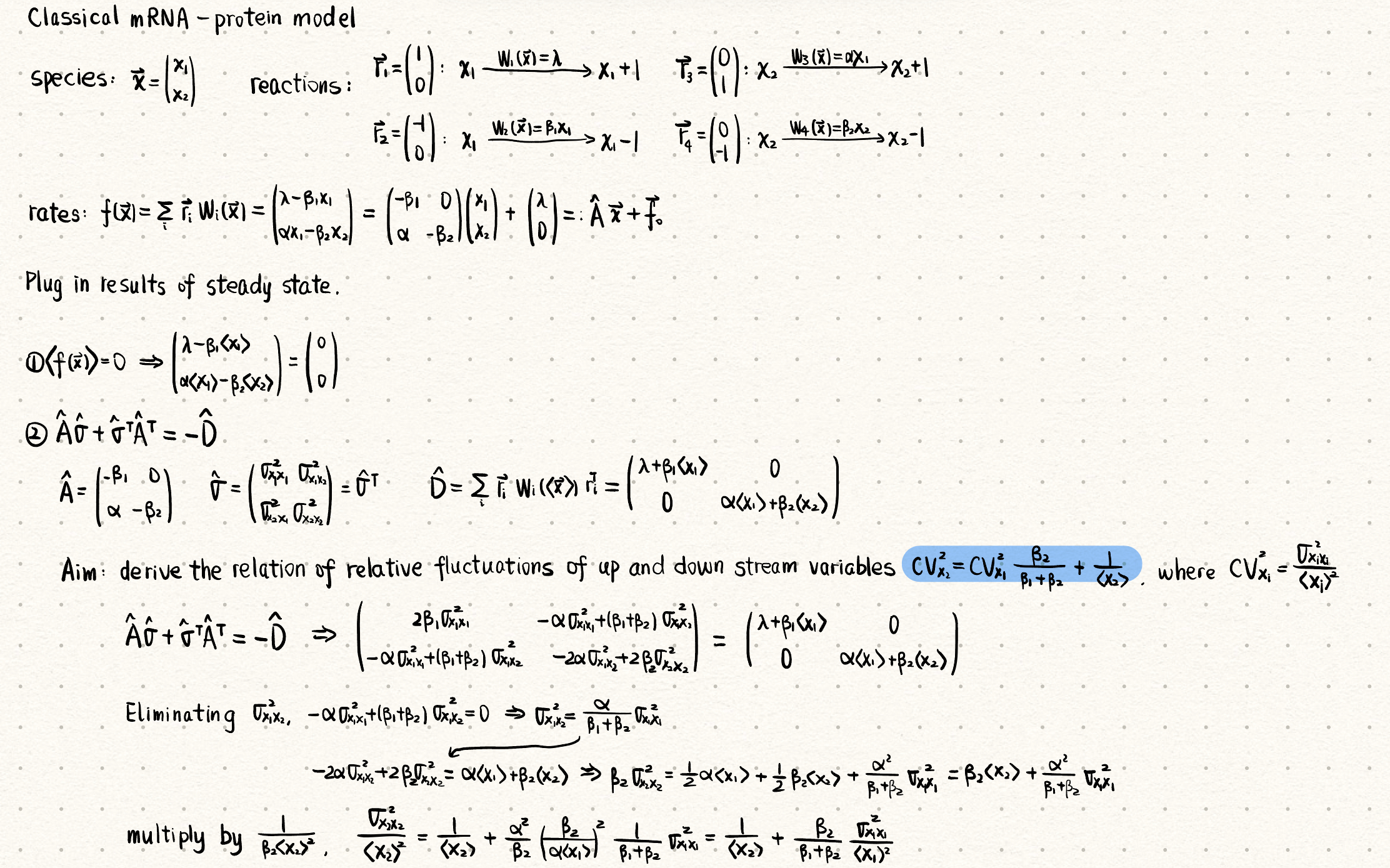
We’ve solved the variance in my previous post, and in the tutorial above the autors used the generating functions to solve the variances.
We’ve known that the steady-state mRNA obeys a Poisson distribution. In 2 the author solved the approximate protein full distribution under the limit that the lifetime of protein is much greater than mRNA (Eq.8), which I don’t bother to practice derivation right now.
Variations
the “three-stage” model including the on-off switch of transcription \(\begin{equation} G \overset{\sigma_{\text{off}}}{\underset{\sigma_{\text{on}}}{\rightleftharpoons}} G^*, \quad G \overset{\rho} G+M, \quad M \overset{d}{\longrightarrow} \emptyset. \end{equation}\) The mRNA distribution was analytically solved in 3.
the “three-stage” model including the on-off switch of transcription and deterministic delay \(\begin{equation} G \overset{\sigma_{\text{off}}}{\underset{\sigma_{\text{on}}}{\rightleftharpoons}} G^*, \quad G \overset{\tau}{\Longrightarrow} G+M, \quad M \overset{d}{\longrightarrow} \emptyset. \end{equation}\) The mRNA distribution was analytically solved in 4.
Random partition
The birth and death of biochemical molecule is random, so does the molecule partition at cell division. The simplest random partition is binomial. How to quantify the moments of molecular abundances before and after cell division?
- \(\langle x(T)\rangle=2\langle x(0)\rangle\) as intuition;
- \(\sigma_x^2(T)=4\sigma_x^2(0)+\langle x(T)\rangle\) as the conclusion from the law of total variance 1.
Using generating functions, properties of all moments can be derived, and is consistent with 1, as shown here. I said we are free to choose “\(z_x\)” or “\(e^{\mu x}\)”, but here we should choose the former to make the form symmetric.
References
- Huh, D., & Paulsson, J. (2011). Random partitioning of molecules at cell division. Proceedings of the National Academy of Sciences, 108(36), 15004-15009.
- Shahrezaei, V., & Swain, P. S. (2008). Analytical distributions for stochastic gene expression. Proceedings of the National Academy of Sciences, 105(45), 17256-17261.
- Peccoud, J., & Ycart, B. (1995). Markovian modeling of gene-product synthesis. Theoretical population biology, 48(2), 222-234.
- Xu, H., Skinner, S. O., Sokac, A. M., & Golding, I. (2016). Stochastic kinetics of nascent RNA. Physical review letters, 117(12), 128101.
文档信息
- 本文作者:L Shi
- 本文链接:https://shi200005-github-io.pages.dev/2026/10/31/Generating-Functions/
- 版权声明:自由转载-非商用-非衍生-保持署名(创意共享3.0许可证)